
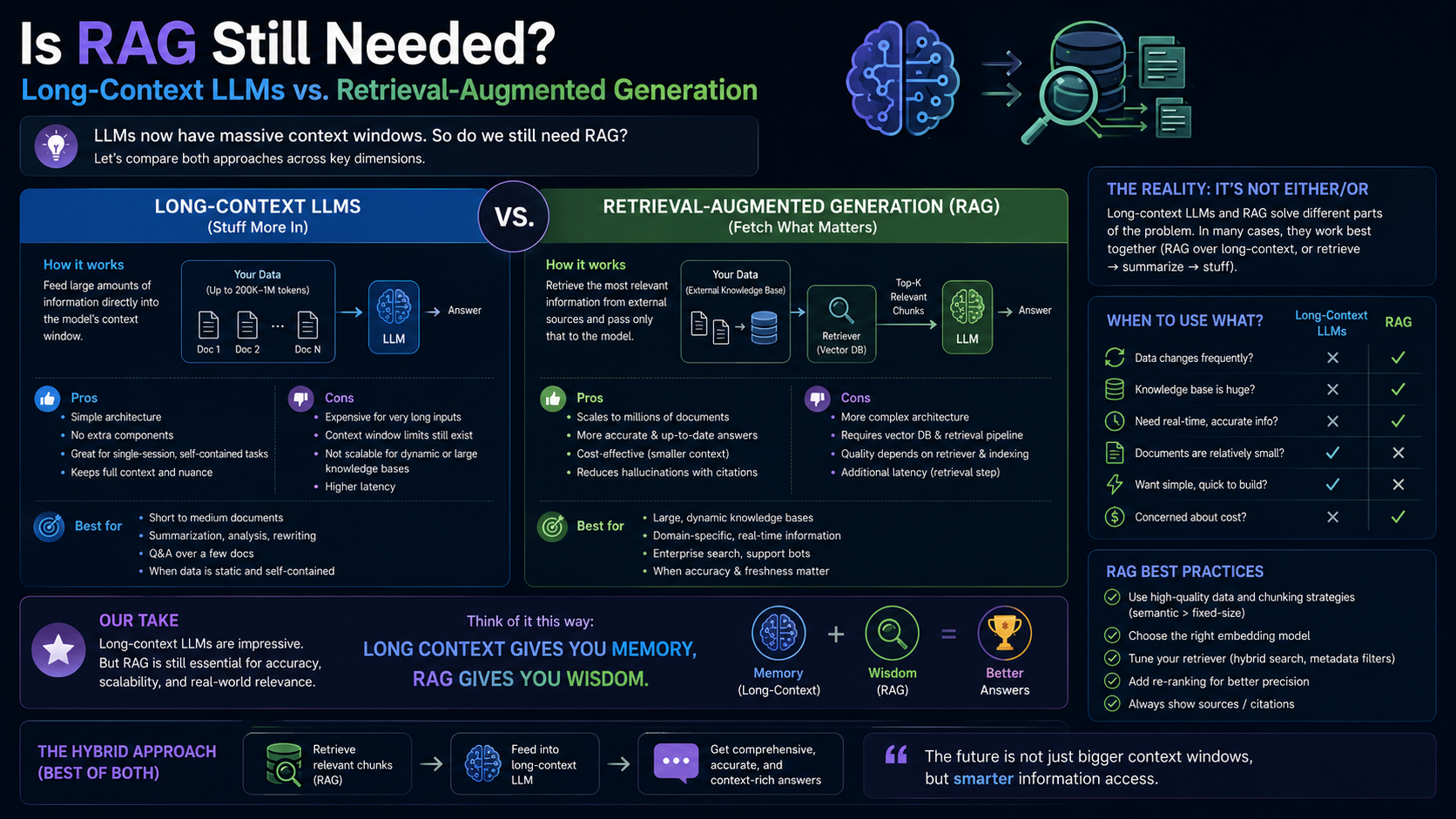
RAG Is Not Dead: Why Long-Context LLMs Still Need Retrieval
There was a time when the biggest limitation of Large Language Models (LLMs) was their context window. Early versions of GPT-4 could process only 8,192 tokens, forcing engineers to build elaborate systems that split documents into chunks, converted them into vectors, and retrieved only the most relevant pieces for each query. That approach became known as Retrieval-Augmented Generation (RAG).
By 2026, the situation has changed dramatically. Frontier models such as Gemini 3.1 Pro and Claude 4.8 Opus can handle context windows ranging from one million to more than ten million tokens.
This has triggered an important debate among AI engineers: Is RAG dead?
Why maintain vector databases such as Pinecone or Qdrant, tune chunking strategies, and write orchestration code when an entire documentation repository or years of financial records can be placed directly into a model’s prompt?
The short answer: RAG is not dead. Long-context models have changed how AI systems are built, but retrieval remains essential for cost control, accuracy, freshness, and enterprise-scale performance.
1. Context Is Expensive
A model’s ability to ingest two million tokens does not mean every query should use two million tokens.
API pricing is generally tied to the number of tokens processed. A simplified cost model is:
Where:
- Ninput is the number of prompt tokens.
- Noutput is the number of generated tokens.
- Pinput and Poutput are the respective per-token prices.
Suppose a developer pastes a one-million-token codebase into an LLM just to ask, “Where is the database timeout configured?” The request may cost around $3.00. If 100 developers perform 50 such lookups per day, the monthly cost can quickly reach tens of thousands of dollars.
With RAG, the system first identifies the relevant configuration files and sends only a focused excerpt—perhaps 2,000 tokens—to the model. That can reduce input-token usage by more than 99%, while producing the same practical answer.
Latency is another issue. Processing millions of tokens requires the model to compute attention across a massive sequence. Even with optimized hardware, long prompts increase Time-To-First-Token (TTFT) and make real-time applications slower. For customer-facing products, internal copilots, and agentic workflows, waiting several seconds before generation begins is often unacceptable.
2. More Context Does Not Mean Better Reasoning
It is tempting to assume that if a model can technically read a million tokens, it can reason perfectly across all of them. In practice, that is not always true.
Models may pass “needle in a haystack” tests by locating a specific fact buried in a long document. However, their ability to synthesize information, follow complex instructions, compare sources, and avoid mistakes can degrade as the input grows.
This is often called the “Lost in the Middle” problem. Attention mechanisms tend to give stronger weight to information at the beginning and end of a prompt. Content in the middle—often the densest and most important part of a large document—can be overlooked, generalized, or misinterpreted.
RAG reduces this problem by acting as a precision filter. Instead of forcing the model to process irrelevant material, it supplies a compact, high-signal set of documents. The result is usually better factual grounding, stronger instruction-following, and fewer hallucinations.
3. Enterprise Data Changes Constantly
Enterprise knowledge is not static. Customer balances change, inventory levels fluctuate, policies are updated, and codebases evolve daily.
If an application depends only on stuffing data into a long prompt, it must repeatedly re-ingest and resend large volumes of information to stay current. That is expensive, slow, and operationally fragile.
RAG separates knowledge storage from reasoning:
- The LLM acts as the reasoning engine.
- The vector database or knowledge graph acts as the live knowledge layer.
When a record changes, only the affected document or vector needs updating. The retrieval layer can then supply the latest relevant information to the model at query time. There is no need to retrain the model or rebuild a giant prompt.
Vector Database / Knowledge Graph = Dynamic Knowledge RAM
This architecture is far better suited to live business data.
4. The Future: Long-Context RAG
Long-context models have not replaced RAG. They have made RAG more powerful.
Earlier RAG systems had to be extremely conservative. Developers often retrieved only the top three to five chunks—sometimes under 1,000 tokens—because the context window was small. This improved cost and speed but sometimes omitted surrounding context, tables, dependencies, or contradictory information.
The modern approach is Long-Context RAG:
User Query
   ↓
RAG Retrieval Layer
   ↓
Retrieve Top 50–100 Relevant Documents
   ↓
Long-Context LLM Performs Deep Reasoning
   ↓
Grounded Answer
Phase 1: High-Recall Retrieval
The retrieval system searches a vector database, hybrid search index, or knowledge graph. Instead of returning only a few tiny chunks, it retrieves the top 50 to 100 most relevant documents—often around 100,000 to 200,000 tokens.
Phase 2: High-Precision Reasoning
The long-context LLM then receives this curated set and performs deeper analysis: cross-referencing facts, resolving conflicts, interpreting tables, and generating a structured answer.
This combines the strengths of both approaches:
| Layer | Role | Benefit |
|---|---|---|
| RAG retrieval | Finds relevant knowledge | Lower cost, fresh data, reduced noise |
| Long-context LLM | Reasons across retrieved content | Better synthesis and contextual understanding |
| Vector database / knowledge graph | Stores and updates enterprise knowledge | Scalable, real-time knowledge management |
The Verdict
RAG is still necessary—especially for production AI systems.
Directly feeding massive documents into an LLM is excellent for one-off research, exploratory analysis, and small private datasets. But it is rarely the right foundation for scalable, cost-efficient, real-time enterprise software.
The strongest architecture is not RAG versus long context. It is RAG plus long context:
- Use retrieval to filter noise and select relevant knowledge.
- Use long-context models to reason deeply over that focused payload.
- Use vector databases or knowledge graphs to keep enterprise knowledge current.
That combination delivers AI systems that are faster, more accurate, more maintainable, and economically sustainable at scale.
Need this done for your business?
We ship AI chatbots, WhatsApp automation and web platforms in weeks. Websites from ₹12,000.