
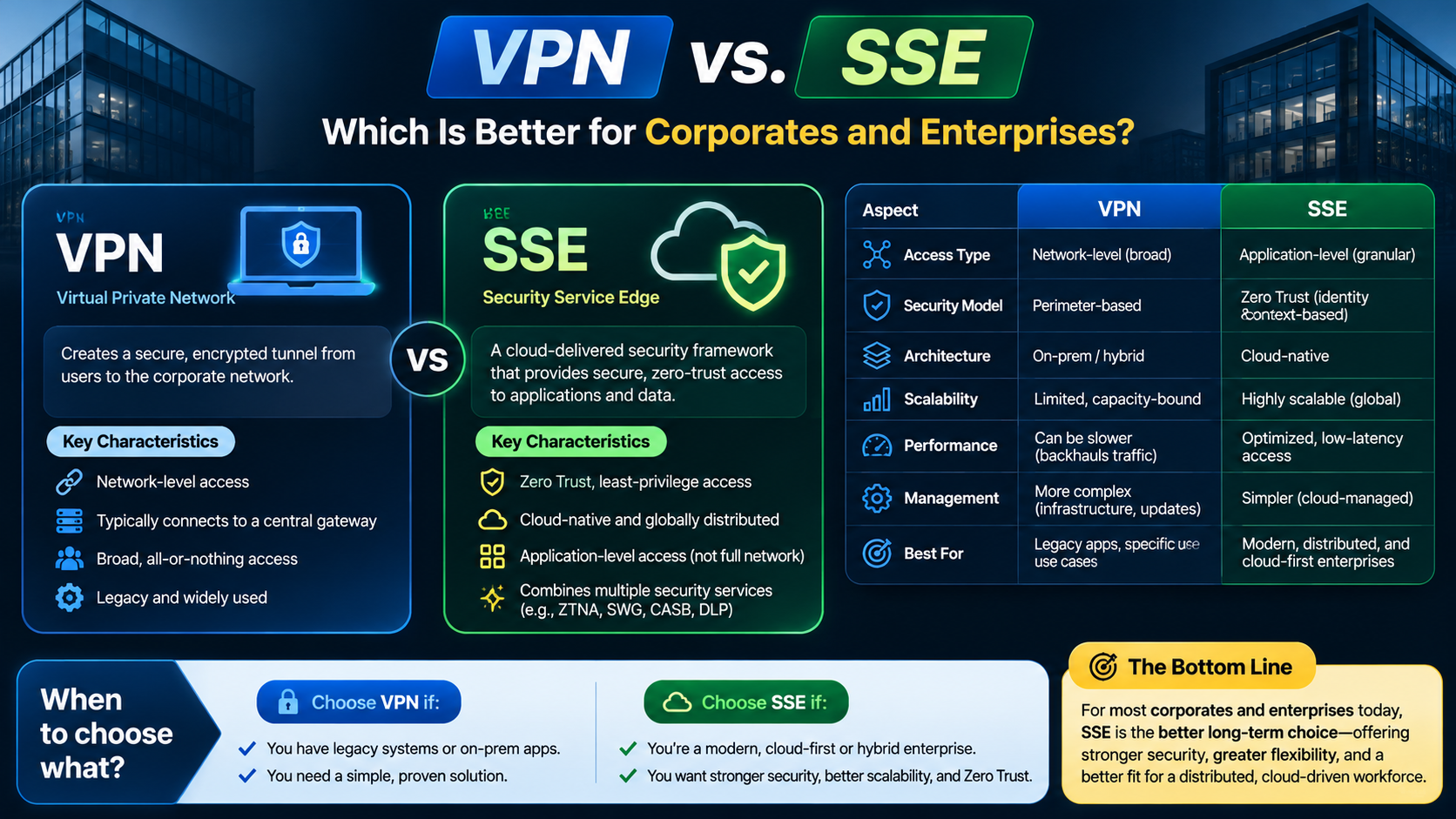
VPN vs. SSE: Which Is Better for Corporates and Enterprises?
For years, the VPN was the default answer to enterprise remote access. It was simple: create an encrypted tunnel, put the user on the corporate network, and trust them to access what they need. But the way we work has changed. Applications now live in the cloud, users work from anywhere, and attackers are increasingly sophisticated. That old network-centric model is showing its age.
Enter SSE — Security Service Edge.
For most modern enterprises, SSE is the better strategic choice for securing remote and hybrid access. However, a VPN can still be the right tool for specific, narrow use cases. The real question is not simply “VPN or SSE?” but rather: what security model does your business need for the next five years?
The Core Difference: Network-Centric vs. Identity-Centric Security
The distinction between VPN and SSE comes down to what they protect and how they protect it.
A VPN (Virtual Private Network) creates an encrypted tunnel that places a user directly “on” the corporate network. Once authenticated, the user typically receives broad network-level access and is often implicitly trusted. This model was designed for a world where applications lived in a central data center and users worked from a managed office.
SSE (Security Service Edge) is a cloud-delivered security framework. It acts as a checkpoint in the cloud that inspects every access request and grants users permission only to the specific applications they need — never exposing the wider network. It bundles several key security technologies into one platform, including Zero Trust Network Access (ZTNA), Secure Web Gateway (SWG), Cloud Access Security Broker (CASB), and Firewall-as-a-Service (FWaaS).
In short: VPN trusts the network. SSE trusts verified identity and context — every time.
VPN vs. SSE: A Head-to-Head Comparison
| Feature | Traditional VPN | Security Service Edge (SSE) |
|---|---|---|
| Security Model | Network-centric & implicit trust: Grants broad network access after a single authentication. A compromised credential can give an attacker a foothold to move laterally across the network. | Zero Trust & least privilege: Verifies identity and device context for every request, granting access only to specific applications. This drastically reduces the attack surface and risk of lateral movement. |
| Access Control | Coarse-grained: Users often get access to network segments or subnets, not just the apps they need. Permissions are hard to maintain and often violate least privilege. | Fine-grained & app-specific: Access is scoped to individual applications (e.g., based on FQDN, IP, or port), ensuring users can only reach what their role requires. |
| Performance & Scalability | Can be a bottleneck: Often requires backhauling traffic to a central data center for security inspection, causing latency and poor performance, especially for cloud and SaaS apps. Scaling requires costly hardware upgrades. | Optimized & scalable: Delivers security from distributed cloud points of presence (PoPs) close to the user, enabling direct-to-app connections without backhauling. Scales elastically with cloud-native architecture. |
| Cost Structure | High capital & operational expenditure: Requires significant upfront investment in VPN concentrators, load balancers, and supporting on-premises infrastructure, plus ongoing maintenance and admin overhead. | Subscription-based (OpEx): Typically priced per-user, per-year. Consolidates multiple point products (VPN, SWG, CASB) into one platform, which can reduce overall licensing and hardware costs. |
| Management Complexity | Complex & siloed: Managing on-premises VPN infrastructure involves patching, capacity planning, and integrating separate tools for authentication and security policy. | Simplified & unified: Provides a single cloud console for managing and enforcing consistent security policies across web, SaaS, and private applications for all users, regardless of location. |
The SSE Advantage: A Consolidated Security Stack
A key strength of SSE is that it consolidates multiple critical security functions into a single, cloud-native platform. This typically includes:
- Zero Trust Network Access (ZTNA): The modern replacement for VPN, providing application-level access based on identity and context.
- Secure Web Gateway (SWG): Filters web traffic to block malicious sites and enforce acceptable use policies.
- Cloud Access Security Broker (CASB): Provides visibility and control over SaaS application usage.
- Firewall-as-a-Service (FWaaS): Delivers cloud-based firewall capabilities to protect users and branch locations.
Instead of stitching together separate tools for remote access, web security, and SaaS control, enterprises get a unified policy engine and a single pane of glass.
When Might a VPN Still Be Considered?
Despite SSE’s advantages, a VPN can still be relevant in specific scenarios:
- Legacy, non-web applications: For accessing certain internal, non-web protocols that some ZTNA solutions may not fully support, a VPN might still be necessary.
- Site-to-site connectivity: For connecting branch offices or data centers to a corporate network at the network layer, a traditional VPN (or SD-WAN) remains a valid technology.
- Specific, narrow use cases: As a transport solution for a small, fixed set of users or devices to a specific network segment, a VPN can be simple and effective.
The key is to avoid using a VPN as the default, broad-access solution for a hybrid workforce.
Summary and Recommendation
For an enterprise aiming to support a modern, hybrid workforce and secure access to a mix of cloud and on-premises applications, SSE is the superior architecture. It aligns with Zero Trust principles, improves security posture, enhances user experience, and offers a more scalable and potentially cost-effective operational model.
The market trend confirms this. Gartner forecasts that up to 70% of new remote access deployments will use ZTNA — a core SSE component — rather than VPN in 2025, up from under 10% in 2021.
The recommended approach is often a phased migration: start by replacing VPN use cases for application access with a ZTNA solution (which can be part of an SSE platform), then expand to other SSE capabilities like SWG and CASB as needs evolve.
Key Takeaways
- VPN = network-centric, implicit trust. Good for site-to-site and narrow legacy use cases.
- SSE = identity-centric, Zero Trust. Better for hybrid work, cloud apps, and reducing attack surface.
- SSE consolidates ZTNA, SWG, CASB, and FWaaS into one cloud-delivered platform.
- Most enterprises should adopt a phased SSE migration rather than extending traditional VPN infrastructure.
What’s your organization’s approach? Are you still relying on VPN for remote access, or have you started a ZTNA/SSE journey? I’d be interested to hear what’s working — and what’s not — in the comments.
Need this done for your business?
We ship AI chatbots, WhatsApp automation and web platforms in weeks. Websites from ₹12,000.